German auto workers protest historic job cuts
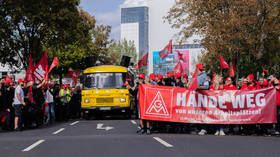
Tens of thousands of auto workers across Germany have staged protests demanding protection for employment and factories after Volkswagen announced plans to cut 100,000 jobs.
Employees at Volkswagen, Mercedes-Benz, BMW, Audi, Porsche, and major suppliers are taking part in more than 280 actions nationwide on Monday. Germany’s largest industrial union, IG Metall, has warned that the country’s automotive industry “faces the risk of total collapse” as it grapples with high energy costs following reduced imports of Russian oil and gas, US tariffs, and growing competition from China.
”We expect corporate leaders and management teams to take responsibility for Germany as an automotive nation, for employees and for jobs,” IG Metall chief Christiane Benner told workers at Volkswagen’s headquarters in Wolfsburg.
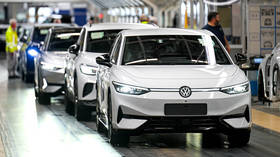
Volkswagen’s planned reductions include some 50,000 previously announced cuts across its brands and another 50,000 under a new agreement. The company also slashed its 2026 operating-margin forecast on Friday to no more than 1%, citing weakness in China, restructuring costs, and problems at Porsche.
Other German carmakers are also scaling back. BMW is cutting about 8,000 jobs, while Mercedes-Benz is reducing production at home and expanding capacity in lower-cost Hungary.
The industrial contraction extends beyond layoffs. Volkswagen ended car production at its Dresden plant last December, marking the first closure of a German car factory in the company’s 90-year history.
The automaker has also dropped out of the Euro Stoxx 50 for the first time in 15 years, with its shares down more than 75% from their 2021 peak. By contrast, shares in German defense giant Rheinmetall have soared over 1,100% since the start of 2022 as Berlin boosts military spending.
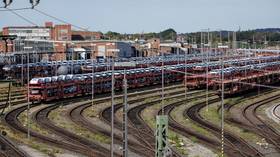
Parts of the automotive sector are also turning to defense. Volkswagen’s Osnabrück plant, where car production is due to end next year, is set to shift toward military manufacturing, with Israeli arms maker Rafael lined up to produce air-defense systems and components. Mercedes-Benz has also explored opportunities in the sector.
Germany has budgeted €108.2 billion ($124 billion) for defense this year, with spending set to rise further under Chancellor Friedrich Merz’s drive to build what he has called Europe’s strongest conventional army.
Moscow has criticized the buildup. Russian President Vladimir Putin said in June that NATO had moved beyond supporting Ukraine and was now “openly” discussing preparations for war with Russia while increasing military budgets.